
© 2026 Monument Traders Alliance, LLC

Elon Musk can launch a rocket into space and bring the booster back to Earth.
But getting magnets for a robot? That required permission from Beijing.
Let that sink in.
And a headline last week showed why this story deserves your attention.
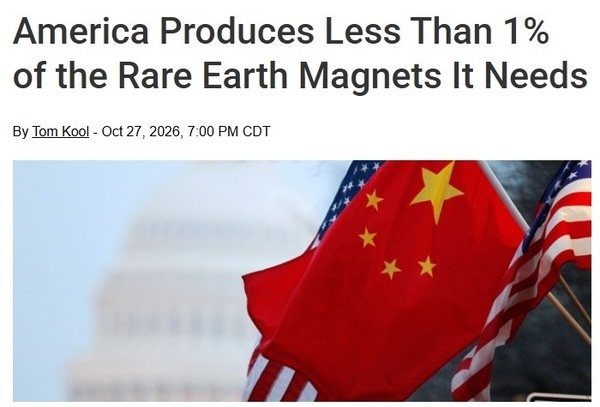 |
It read, “America Produces Less Than 1% of the Rare Earth Magnets It Needs.” The number refers to the roughly 300 tonnes it produced domestically versus 48,000 tonnes used in 2025.
That’s like throwing a dinner party for 160 people and setting out enough food to feed one.
You’d better hope the grocery store stays open.
For American manufacturers, reliable access to these materials is a serious business problem. For investors, the companies helping solve it deserve a closer look.
To understand why, go back to Tesla’s (TSLA) April 2025 earnings call.
Musk explained that China’s export restrictions had affected Optimus, Tesla’s humanoid robot. The company needed rare-earth magnets and was working to obtain an export license. Beijing wanted assurances the magnets wouldn’t be used for military purposes.
Imagine planning a robot workforce, lining up engineers, developing the software…
Then waiting for approval to ship a component.
That’s an expensive waiting room.
It also reveals something investors often overlook: A breakthrough product is only as strong as the supply chain behind it.
You can have brilliant engineers and customers ready to buy. But if one essential component doesn’t arrive, your production schedule can unravel.
That’s why I pay attention to the businesses working on alternatives.
And there’s already money going into the buildout.
USA Rare Earth (USAR) recently broke ground on a planned $1.2 billion rare-earth metals and manufacturing facility in South Carolina. The project is part of the company’s effort to connect more stages of production under one roof.
That matters because digging material out of the ground is only part of the job. Manufacturers need usable metals, alloys, and finished components.
But a groundbreaking ceremony doesn’t pay shareholders. A business eventually has to deliver.
Let’s take this and put it to work for our investment portfolio.
First, we need to identify the bottleneck. What specific component is holding customers back? A company solving a processing problem may have a very different opportunity from one developing a mine.
Second, look for evidence that the alternative works. Customer testing, purchase orders, and repeat business tell you much more than an exciting presentation. Lately, I’ve been taking that idea further than ever… reading purchase orders most of Wall Street skips, tracking job postings and even studying factory buildouts from space. I’ll show you what that research turned up very soon.
Third, examine whether the supplier can produce enough. And, just as important, earn money doing it. Check its cash, construction costs, and whether it may need to issue more shares to fund expansion.
Finally, check the stock’s valuation. Even a terrific business can be a disappointing investment if you pay a price that assumes everything goes perfectly.
USA Rare Earth is an example to investigate through that framework. Its construction announcement alone wouldn’t convince me to buy.
Those questions help separate a compelling headline from a potential investment.
They’re also central to something new I’ve been building – a research service focused on emerging businesses solving important problems, with evidence their moment may be approaching. I’ll have more to share very soon.
Musk’s magnet problem offers a useful reminder: Sometimes the business worth investigating is the one building the missing piece. And sometimes, it’s the one making that piece unnecessary.
