
© 2026 Monument Traders Alliance, LLC

What’s the answer to the ultimate question of life, the universe, and everything?
(Hint: it’s 42.)
At least, that’s what Deep Thought came up with. In Douglas Adams’ The Hitchhiker’s Guide to the Galaxy, the supercomputer spends 7.5 million years on that question and finally delivers its answer. Then it admits no one ever really understood the question in the first place.
Its solution? Design an even more powerful computer to figure it out.
When the book came out in 1979, a machine you could ask anything was pure science fiction.
And for decades, it stayed that way. Researchers promised computers that could think, write, and solve problems like humans. But progress was painfully slow, and most people assumed truly intelligent machines were still generations away.
Then a series of breakthroughs (starting with the launch of ChatGPT in November 2022) changed everything. Suddenly AI was writing emails, diagnosing diseases, and transforming entire industries… and giving far more useful answers than 42.
Now the next leap may come from an even more powerful kind of computer. What I’m seeing unfold in quantum computing today reminds me of where AI was to start this decade.
And two breakthroughs announced over the past few days suggest this emerging technology may be advancing much faster than most investors realize.
Before we get to the exciting news, there’s something you need to understand about quantum computing.
Traditional computers use bits that represent either a zero or a one. Quantum computers use qubits, which can exist in combinations of both states simultaneously. This allows quantum machines to approach certain extraordinarily complex calculations in ways conventional computers cannot.
The potential applications are enormous, from discovering new medicines and developing advanced materials to designing better batteries and solving complicated scientific problems.
But there’s a catch.
Qubits are incredibly fragile. Even tiny disturbances can introduce errors that ruin calculations. And as quantum computers become more powerful, managing those errors becomes increasingly difficult.
For years, companies have competed to build machines with more qubits. But having thousands of qubits doesn’t accomplish much if they can’t produce reliable answers.
That’s why the latest announcements are so important.
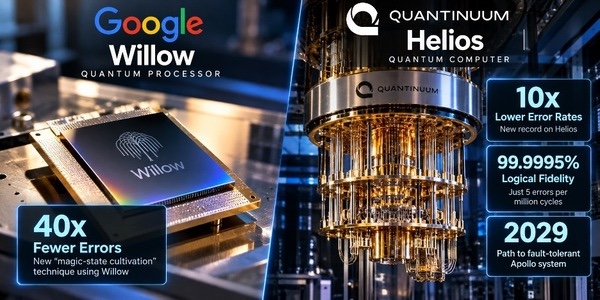
First came Google (GOOGL), which announced a major advance using its Willow quantum processor.
Researchers demonstrated a technique called magic-state cultivation that reportedly reduced errors by approximately 40 times in a critical process needed for advanced quantum calculations.
You don’t need to understand the complicated physics to appreciate what this means. Google is developing ways to make quantum computers dramatically more reliable, potentially reducing the enormous amount of hardware required to perform useful calculations.
Then came an equally impressive announcement from Quantinuum (QNT).
On Monday, the company reported that its Helios quantum computer achieved a tenfold reduction in logical error rates compared with its previous record.
Logical qubits combine multiple physical qubits with error-correction techniques to protect quantum information. Improving their reliability is essential to building machines capable of solving real-world problems.
Quantinuum reported logical fidelity of approximately 99.9995% in its error-correction experiment. That’s an extraordinary achievement, although it doesn’t mean the computer can already perform every quantum operation with that level of accuracy.
And here’s what really caught my attention: Quantinuum believes this progress supports its roadmap toward a fault-tolerant quantum computer called Apollo by 2029.
That’s just three years away.
 |
Now here’s where this gets particularly interesting for investors.
Despite the accelerating technological progress, quantum computing stocks have experienced significant volatility and sharp pullbacks from their highs.
Companies like IonQ (IONQ), D-Wave Quantum (QBTS), and Rigetti Computing (RGTI) have all attracted enormous investor enthusiasm, followed by periods of aggressive selling.
Some of that skepticism is justified. Many quantum companies remain unprofitable, their valuations anticipate substantial future growth, and widespread commercial adoption is still years away.
But I see something that reminds me of the early internet.
In the 1990s, investors struggled to determine which companies would eventually dominate the digital economy. Stock prices fluctuated wildly, even as the underlying technology continued improving.
We’re witnessing a similar disconnect today.
The market is focused on near-term revenue, valuations, and quarterly stock performance. Meanwhile, researchers are solving fundamental problems that could eventually unlock an entirely new computing industry.
And the opportunities won’t necessarily be limited to companies building quantum computers. Specialized lasers, photonics, advanced semiconductors, cryogenic cooling, and precision measurement systems will all play important roles.
Some of the biggest winners could emerge from these less obvious corners of the quantum ecosystem.
The biggest breakthroughs rarely arrive all at once. They happen incrementally, until suddenly the technology crosses a threshold that changes everything.
Quantum computing hasn’t reached that point yet. But Google’s 40-fold improvement and Quantinuum’s tenfold advance suggest we’re moving closer.
That doesn’t mean investors should blindly buy every quantum stock that’s fallen 30% or 40%. Valuations matter, execution matters, and plenty of companies won’t survive the journey.
But the recent weakness deserves attention rather than fear.
The quantum revolution is still in its early innings. And while Wall Street worries about the latest stock market pullback, some of the most important breakthroughs are happening right before our eyes.
P.S. Google’s quantum breakthrough is a story that will play out over years. Next week, Wall Street’s attention turns to something much more near-term: Google’s earnings, along with reports from Microsoft and Amazon. My colleagues CJ and Nate Bear are previewing those big reports tomorrow at 2 p.m. ET. They’ll also cover the elections and what could be the biggest sector rotation in more than a year. It’s free. Save your spot here.
