
© 2026 Monument Traders Alliance, LLC

Six years ago, I was walking the floor at the Consumer Electronics Show (CES) in Las Vegas when I got my hands on something that immediately caught my attention: a foldable smartphone.
This was January 2020, and foldable phones (and coronavirus) were just beginning to emerge.
Samsung had introduced its first Galaxy Fold the year before, and Chinese manufacturers were racing to develop their own versions (of phones, not viruses…).

I still have a picture from CES holding one of those early Chinese foldable phones.
At the time, it felt like I was getting a glimpse of what the smartphone of the future might look like.
It turns out the future took a little longer than I expected. Six years later, Apple (AAPL) has finally joined the party with its first foldable iPhone: the iPhone Duo.
And as we’ve seen countless times before, Apple doesn’t necessarily need to invent a technology to completely change the market for it.
Apple wasn’t the first company to build a personal computer, MP3 player, smartphone, or smartwatch. Its strategy has often been to let other companies experiment first, wait for the technology to improve, and then enter with a product designed for the mass market.
The iPhone Duo could follow that same playbook. Apple’s new book-style phone has a roughly 5.5-inch exterior display that opens into a 7.8-inch interior display, essentially putting a small tablet in your pocket.
The price starts at $2,000, so Apple clearly isn’t trying to win on price. Instead, it’s betting that consumers will pay a premium for something that can function as both an iPhone and a small iPad. The Duo even supports the Apple Pencil, another indication that Apple sees the larger screen as more than a gimmick.
Wall Street sees a potentially huge opportunity. Morgan Stanley estimates Apple could initially ship roughly 6.5 million foldables, potentially generating around $14 billion in December-quarter iPhone revenue. Other analysts believe Apple could capture approximately 40% of the foldable market by the end of 2027.
That’s remarkable considering Apple showed up roughly seven years after Samsung.
The reason Apple waited is probably pretty simple. Early foldables had problems. They were thick, hinges created durability concerns, screens developed obvious creases, and consumers weren’t always convinced that paying a huge premium for a phone that folded was worth it.
Foldables still represent only a small percentage of global smartphone sales. So, the real opportunity isn’t Apple stealing existing foldable customers from Samsung or Chinese competitors. It’s Apple convincing hundreds of millions of existing iPhone users that their next upgrade should fold.
If that happens, the entire category changes.
There’s another reason I believe Apple’s timing could prove interesting: artificial intelligence is changing what we expect from our phones.
The iPhone Duo is powered by Apple’s A20 Pro chip, designed to handle increasingly demanding AI workloads. Apple wants more AI processing to happen directly on the device, where it can be faster and more private.
We’re also moving beyond asking an AI assistant simple questions. AI agents will increasingly analyze documents, edit photos, summarize information, create content, and operate applications for us. That makes screen real estate more valuable, and a phone that unfolds into nearly eight inches suddenly starts looking like a portable AI workstation.
The foldable screen and the AI revolution may be arriving at exactly the right time for each other.
From an investment standpoint, I don’t believe Apple will be the only winner if foldables take off. Apple’s entrance could accelerate an entirely new smartphone upgrade cycle, benefiting companies throughout the supply chain.
Samsung is particularly interesting because it competes against Apple in foldables while its display business is also expected to supply Apple’s advanced OLED screens.
Taiwan Semiconductor (TSM) manufactures Apple’s A20 Pro chip and stands to benefit as increasingly powerful AI-capable processors require leading-edge semiconductor technology.
Two other picks-and-shovels companies could benefit directly from the Duo.
Amphenol (APH) has been identified as one of the suppliers of its sophisticated hinge system – a critical component considering that durability and the visible crease have been two of the biggest challenges facing foldable phones.
Corning (GLW) has also been reported as a potential supplier of the ultra-thin glass used to protect the foldable display.
The Duo alone won’t dramatically change the financials of either company, but if Apple helps push foldables into the mainstream, demand for these specialized components could grow considerably as Apple and its competitors roll out future generations.
Then there are potential opportunities throughout memory, advanced packaging, cameras, specialty materials, and semiconductor manufacturing equipment.
It’s another example of my favorite picks-and-shovels approach. We don’t always need to predict which finished product ultimately wins. Sometimes the better opportunity is finding the companies supplying technology that an entire industry needs.
When I held that foldable phone at CES six years ago, it was in the earliest stages of the McCall Innovation Curve.
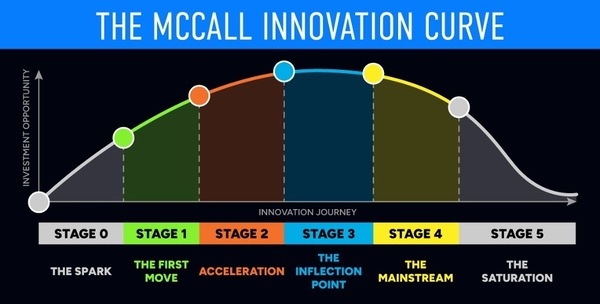 |
The technology worked, but mass-market demand wasn’t proven.
Samsung and others spent the next six years improving it. Now Apple has decided the technology is finally ready for its customers.
That doesn’t guarantee the iPhone Duo will be a hit. At $2,000, Apple is asking consumers to pay a substantial premium. But Apple wasn’t first to the smartphone or smartwatch either.
Sometimes being first doesn’t matter nearly as much as being the company that takes a technology mainstream.
Six years after I first held the future in my hands at CES, we may finally be reaching that moment.
P.S. The AI story doesn’t stop at your phone. It’s already rewritten how the stock market moves. The Economist estimates algorithms now drive up to 80% of U.S. stock and ETF activity, which means most of the actions on any given day aren’t made by human decisions, they’re made by code.
My colleague Bryan Bottarelli has been picking apart that shift for months, and he’s found a strange byproduct he calls a “Flash Rally” that shows up right before certain stocks make an outsized move, with a 98% accuracy rate across more than 7,000 setups going back 10 years.
Using this method, he’s clocked gains as high as 695%, including one trade that would have turned $1,000 into $10,580.
He’s opening up the entire strategy live on September 16 at 2 p.m. ET… the exact trigger, the scanner he built to track it, and real setups forming on the open market while you watch.
If algorithms are going to keep running this show, it’s worth seeing how Bryan’s found a way to trade alongside them instead of against them.
