
© 2026 Monument Traders Alliance, LLC

Imagine walking into a department store where nearly half the merchandise is marked down 20%, 30%, or even 40%. Meanwhile, the store manager tells you business has never been better, and sales are practically at record highs.
You’d probably wonder what he’s been drinking.
But that’s essentially what’s happening in the stock market right now. And while Wall Street seems increasingly nervous about the recent pullback, I’m looking at the same numbers and seeing something very different.
One of the biggest buying opportunities of this bull market may already be developing right under our noses.
As of Friday’s close, the S&P 500 was trading roughly 2% below its all-time high. The index is still up about 13% this year, despite the recent volatility.
Sounds like a pretty healthy market, right?
Well, here’s where things get interesting. According to MarketWatch, 191 companies in the S&P 500 are already in bear-market territory, meaning their shares have fallen at least 20% from their 52-week highs.
That’s nearly 40% of America’s most widely followed stock index!
And the weakness goes much deeper. Reuters recently reported that more than 40% of S&P 500 stocks are actually down for the year, while the median stock has gained just 4%. In other words, the average investor’s experience looks very different from what the headlines suggest.
The reason is simple. The S&P 500 is weighted by market capitalization, meaning the largest companies have the greatest influence on its performance. A handful of giants like Nvidia (NVDA), Micron (MU), and Apple (AAPL) can keep the index elevated even while hundreds of other stocks struggle.
And we’re seeing that divergence across the market.
Industrials have pulled back more than 10%, transportation stocks more than 11%, and biotechnology more than 15%, based on the sector measures I’ve been following. Semiconductor stocks, which have been among the biggest beneficiaries of the AI revolution, have also experienced a sharp correction.
The S&P 500 isn’t in a bear market, but a surprising number of its companies already are.
Now take a look at this chart.
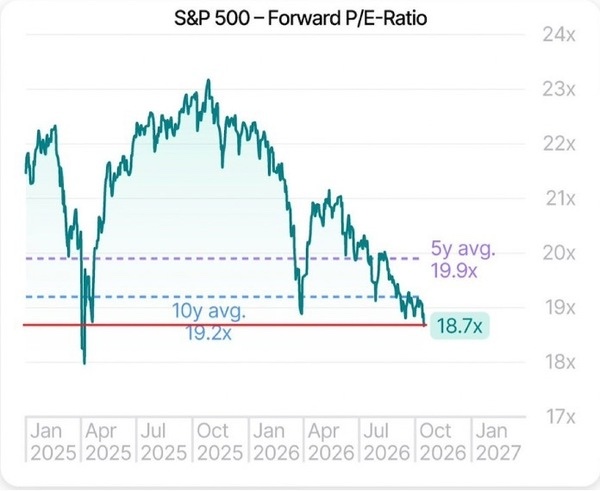 |
Over the past year, the S&P 500’s forward price-to-earnings ratio has fallen from approximately 23.2 to 18.7.
That’s nearly a 20% decline in valuation, even though the index itself remains relatively close to record highs.
The forward P/E ratio measures how much investors are paying for each dollar of expected earnings. A falling multiple means stocks are becoming less expensive relative to their projected profits.
At 18.7 times forward earnings, the S&P 500 is trading below both its five-year average of 19.9 and its 10-year average of 19.2.
Now, that doesn’t mean stocks are historically dirt cheap. And earnings forecasts could certainly change if economic conditions deteriorate.
But I find it encouraging that valuations are becoming more reasonable while many businesses continue growing.
I’ve spent nearly 25 years investing through bull markets, bear markets, bubbles, and crashes. And one of the most important lessons Ive learned is that the best opportunities rarely appear when everyone feels comfortable buying stocks.
They emerge when uncertainty creates a disconnect between a company’s stock price and its long-term potential.
That’s exactly what I’m looking for today.
Consider the opportunities developing in robotics, advanced energy, biotechnology, and AI infrastructure. These industries aren’t going to stop innovating because inflation remains stubborn or investors suddenly become nervous about interest rates.
Companies developing breakthrough medicines will continue their research, manufacturers will keep investing in automation, and the enormous infrastructure required to support AI will still need to be built.
Of course, not every beaten-down stock is a bargain. Some companies deserve lower valuations, and higher interest rates could create additional pressure.
But others are growing earnings, strengthening their competitive positions, and benefiting from powerful trends that could last another decade.
Those are the companies I want to own.
And here’s what makes today’s setup especially interesting. We don’t necessarily need the entire market to surge higher for these opportunities to work. A broadening rally, in which investors begin rotating into overlooked companies and sectors, could create substantial gains even if the major indexes advance more slowly.
I’ve said repeatedly that I believe we’re closer to 1995 than 1999 in this innovation-driven bull market.
The latest market weakness hasn’t changed that belief.
In fact, it’s making me more excited about what’s coming next.
Because while everyone else is waiting for the next big correction, I’m finding plenty of stocks that have already experienced one.
