
© 2026 Monument Traders Alliance, LLC

You just bought a brand-new house in Arizona. Congratulations!
You visit the construction site expecting to see dozens of workers smoking cigarettes, swinging hammers, cutting lumber, and assembling walls under the scorching desert sun.
Instead, much of the framing has already been completed… By robots.
And get this: Those robots did it in just eight to 10 hours.
This isn’t science fiction. It’s happening in the homebuilding industry, and America’s largest homebuilder is getting involved.
We’re witnessing the beginning of one of the biggest economic transformations of our lifetime.
Earlier this month, D.R. Horton announced a partnership with Canadian startup Promise Robotics to bring AI-powered robotic manufacturing into residential construction.
The initial agreement covers components for more than 1,250 homes in the Phoenix area.
Here’s how it works.
Promise takes existing architectural plans and feeds them into an AI-powered system. That software directs industrial robotic arms to cut, position, and assemble the structural components of a house inside a factory.
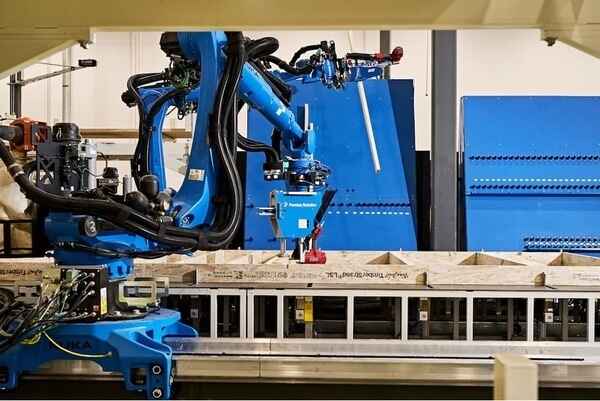 |
Those components are then transported to the construction site, where a traditional crew can assemble the framing in another five to six hours.
To be clear, we’re talking about the framing, not an entire finished house. Plumbing, electrical work, roofing, inspections, and plenty of other tasks still need to happen.
But think about what this could mean for an industry that still builds homes the same way it did generations ago.
Less wasted material. More predictable construction schedules. Fewer weather delays. And almost certainly lower costs.
The Phoenix operation is expected to begin production in early 2027, so the full economic benefits remain to be proven. But D.R. Horton is putting this technology to a serious commercial test.
Yesterday, I told you about humanoid robots helping manufacture components for other humanoid robots in China.
Today, we’re talking about robots building houses in Arizona.
See the pattern?
For years, Wall Street treated robotics as a futuristic investment theme. Something that might become important in 2035 or 2040.
I think that’s a mistake.
The robotics revolution isn’t waiting for the future. It’s already moving into the real economy.
Factories. Warehouses. Hospitals. Farms. Construction sites.
And eventually, our homes.
The opportunity isn’t limited to humanoid robots that look like people. In fact, some of the biggest productivity improvements could come from machines that look nothing like us.
A robotic arm doesn’t need a face, legs, or a personality to transform an industry.
It just needs to perform a valuable task faster, more consistently, or more economically.
Here’s something Wall Street is dramatically underestimating.
AI isn’t just about replacing tasks performed on computers. It’s about making the physical world more productive.
And that could have enormous implications.
Imagine factories operating around the clock, farms harvesting crops with fewer workers, and construction companies building homes faster despite shortages of skilled labor.
Now imagine what happens when these technologies become cheaper and more capable every year.
That’s how technological revolutions create wealth.
The internet didn’t just change how we communicate. It transformed retail, advertising, entertainment, banking, and countless other industries.
Physical AI could have an equally profound impact on the world around us.
And investors need to start thinking beyond the obvious technology stocks.
The opportunity will extend into industrial automation, sensors, motors, precision components, machine vision, and the companies integrating these technologies into everyday operations.
Not every robotics company will succeed. Some stocks already reflect enormous expectations. And commercial adoption will take time.
But waiting until robots are everywhere could mean missing some of the most exciting investment opportunities.
That’s why I’m positioning for this trend now.
Because the next great AI breakthrough might not be another chatbot.
It might be the machine building your next house.
