
© 2026 Monument Traders Alliance, LLC

I’m going to say something that might sound strange after watching AI stocks get hammered this week.
I think this selloff could be one of the best things to happen to AI investors in a long time.
Not because I enjoy watching stocks fall. I certainly don’t. But when an investment theme becomes as popular as AI has over the last few years, eventually something needs to separate the companies building real businesses from those simply riding the wave.
I believe that separation is beginning right now.
Earlier this week, investors didn’t discriminate. Nvidia (NVDA), AMD (AMD), Micron (MU), Oracle (ORCL), and CoreWeave (CRWV) all fell.
If your company had anything to do with AI, investors seemed happy to hit the sell button.
That’s what happens when fear enters a crowded trade. But after the initial panic subsides, investors start asking much better questions.
And that’s when things get interesting.
The first stage of the AI bull market was relatively easy.
ChatGPT exploded onto the scene in late 2022, and investors quickly realized that building artificial intelligence would require an enormous amount of computing infrastructure.
Nvidia became the poster child, but money poured into semiconductors, servers, networking, data centers, power equipment, and practically anything else connected to AI.
For a while, simply having an AI story was enough.
I don’t think that’ll work nearly as well in the next phase.
We’re reaching the point where investors are going to demand proof. Is AI actually producing revenue? Are customers spending real money? Are margins improving? And perhaps most importantly, does the growth justify the stock’s valuation?
Those questions are going to create winners and losers.
I’d start with the companies already cashing the AI checks.
Dell Technologies (DELL), for example, recently reported roughly $61 billion in AI-server orders and a $95 billion backlog. That’s not an AI concept. That’s customers placing enormous orders for actual hardware.
The same principle applies across the picks-and-shovels ecosystem. Semiconductors, memory, networking, cooling, power generation, and electrical infrastructure are all benefiting from real dollars being spent today.
But there’s another side to this equation that I think becomes increasingly important.
The companies spending those billions now need to show investors what they’re getting for their money.
Microsoft (MSFT), Alphabet (GOOG), Amazon (AMZN), and Meta (META) are pouring staggering amounts of capital into AI infrastructure.
Eventually, Wall Street’s going to want something more than another announcement about a bigger data center.
Show me the return.
The companies that can use AI to create new revenue streams, improve productivity, and expand margins could become the next great winners. Those that simply spend billions because everyone else is spending billions could have a much harder time.
Then we have what I call the AI tourists.
You know the companies I’m talking about. Management discovers the hottest investment trend, suddenly mentions “AI” 47 times on an earnings call, and magically becomes an AI company overnight.
I’ve seen this movie before.
During the dot-com boom, practically every company wanted an internet strategy. During the crypto boom, companies couldn’t say “blockchain” enough.
AI is no different.
When money is easy and stocks are going straight up, Wall Street doesn’t always care. But periods like we’re experiencing right now expose weak stories quickly.
That’s healthy.
This fits perfectly with my McCall Innovation Curve.
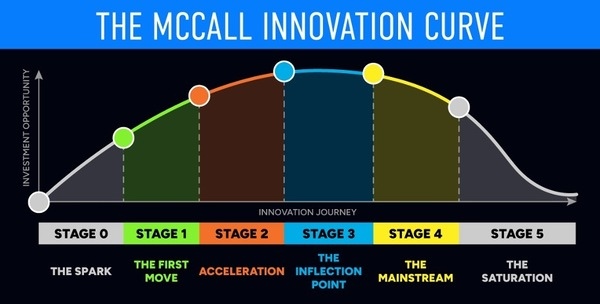 |
The first stage is proving that a technology works. AI has already cleared that hurdle.
Now we’re increasingly moving into the next stage: proving the business model works.
That means I’m not interested in abandoning AI because of a scary week in the market. I’m interested in using the volatility to identify which companies are advancing up the curve and which ones are being left behind.
And I suspect the next group of AI leaders won’t look exactly like the last one.
Some semiconductor stocks will continue winning. Others won’t.
Some software companies could emerge as enormous beneficiaries as businesses actually deploy AI. The software ETF was up over 5.5% on Monday.
And some of the biggest opportunities may come from areas investors haven’t fully appreciated yet… power, robotics, healthcare, defense, and entirely new applications we haven’t even imagined.
The Separation Has Already Begun
I’m still extremely bullish on AI.
But being bullish on AI doesn’t mean being bullish on every AI stock.
In fact, I believe this week’s volatility could ultimately make us better investors. It’s forcing Wall Street to stop buying a theme and start analyzing the businesses underneath it.
The first AI bull market rewarded almost everyone.
I don’t think the next one will.
And our job is to figure out which companies will lead it.
P.S. It’s no secret that AI’s emergence has flooded our lives in nearly every way over the last couple years. And while it provides trading opportunities for savvy futurists like us, its presence can seem overwhelming.
So, I’d like to hear your thoughts… How do you really feel about AI?
