
© 2026 Monument Traders Alliance, LLC

Imagine discovering a treasure worth hundreds of billions of dollars. Now imagine that treasure isn’t buried beneath a mountain, hidden in a desert, or locked inside an abandoned mine.
It’s sitting on the bottom of the Pacific Ocean, nearly three miles underwater.
And instead of gold bars or diamonds, this treasure comes in the form of ordinary-looking rocks about the size of potatoes. But don’t let their appearance fool you. These rocks could help power the next great technological revolution.
Deep beneath the Pacific Ocean lies an enormous region known as the Clarion-Clipperton Zone. Stretching across millions of square miles between Hawaii and Mexico, its seafloor is covered with billions of mineral-rich rocks called polymetallic nodules.
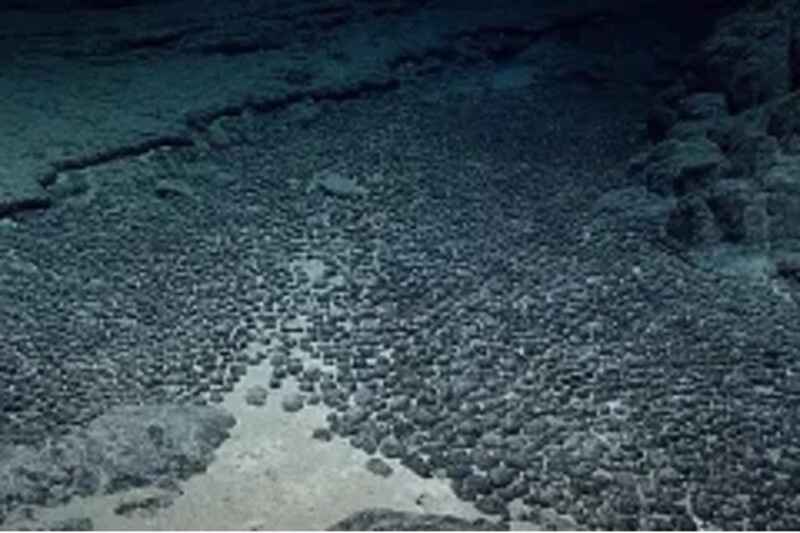
These nodules have been forming for millions of years as dissolved metals slowly accumulate around tiny objects on the ocean floor.
And they contain four metals that are becoming increasingly important to the global economy: nickel, cobalt, copper, and manganese.
Now consider what’s happening above the ocean. Artificial intelligence is driving massive investment in data centers. Automakers are electrifying their fleets. Robotics companies are developing machines that could transform factories, warehouses, and construction sites.
All these innovations have something in common. They require enormous amounts of physical infrastructure, and that infrastructure requires metals.
For centuries, mining has meant digging into the Earth. We’ve blasted mountains, excavated enormous pits, and built tunnels thousands of feet underground to reach valuable mineral deposits.
But what if the next great mining frontier doesn’t require digging at all?
The nodules in the Clarion-Clipperton Zone are already lying on the seafloor. Companies are developing robotic collection systems designed to gather them and transport them to ships on the surface.
Think of a giant underwater vacuum cleaner operating nearly three miles beneath the waves.
The technology is extraordinary. These machines must navigate crushing pressure, near-freezing temperatures, and complete darkness while operating thousands of miles from major industrial centers.
Advances in robotics, sensors, and autonomous systems are making this kind of operation increasingly feasible. What once sounded like science fiction is now being tested in the real world.
We could be approaching the birth of an entirely new mining industry.
Here’s what makes this story particularly exciting.
The world’s racing to secure critical minerals at the same time geopolitical tensions are exposing vulnerabilities in existing supply chains. China dominates the processing of several strategically important materials, while opening a conventional mine can take many years.
That creates an enormous incentive to explore alternative sources. And deep-sea mining could eventually become an important part of the solution.
Of course, there are hurdles. Scientists have raised serious concerns about potential damage to deep-ocean ecosystems, and commercial mining still faces regulatory and economic uncertainty. Those challenges must be addressed before the industry can operate at scale.
But the possibility is remarkable. For the first time, we may have the technology and economic motivation to recover mineral resources that have remained beyond humanity’s reach for millions of years.
Think about the history of investing. Some of the greatest opportunities emerged when new technology opened an entirely new frontier.
Railroads connected a continent. Oil transformed transportation. The internet connected billions of people. Each revolution created industries that barely existed a generation earlier.
Could deep-sea mining eventually join that list?
It’s too early to know how quickly this industry will develop or which companies will succeed. But the opportunity deserves our attention.
Because while most investors are looking toward the sky for the next technological breakthrough, one of the most fascinating opportunities on Earth may be hiding in the opposite direction.
15,000 feet beneath the ocean.
