
© 2026 Monument Traders Alliance, LLC

Remember the winter of 2015–2016?
I sure do. Living in the Northeast at the time, I remember walking through New York City and seeing cars practically buried under mountains of snow. My backyard back then, Central Park, received more than two feet of snow during one massive January blizzard.
Meanwhile, other parts of the country experienced unusually warm temperatures, while California dealt with its own share of unpredictable weather.
Behind some of those extreme weather patterns was a powerful phenomenon called El Niño.
Well, Mother Nature may be preparing something even bigger.
Meteorologists are warning that the developing Super El Niño could become the strongest ever recorded, potentially reshaping weather patterns around the world this winter.
And while most people are wondering whether they’ll need snow shovels or umbrellas, I’m thinking about something else.
The investment opportunities hiding behind one of nature’s most powerful forces.
El Niño occurs when unusually warm water develops across the equatorial Pacific Ocean, disrupting atmospheric circulation and shifting weather patterns thousands of miles away.
The current event could be extraordinary. Some researchers suggest it could rank among the strongest in centuries, although its ultimate intensity remains uncertain.
And the implications extend far beyond a few snowstorms.
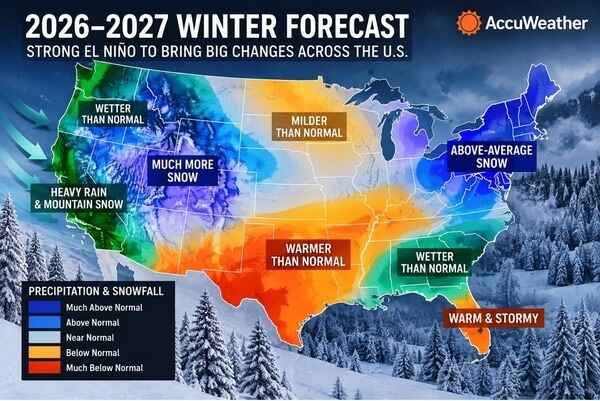
According to AccuWeather’s winter forecast, California could experience powerful atmospheric rivers bringing flooding, landslides, and heavy mountain snow. The southern United States could see more frequent storms, while much of the northern country experiences warmer-than-average temperatures.
Here’s a statistic that caught my attention: AccuWeather forecasts 50–65 inches of snow in Salt Lake City, compared with just 3.7 inches last winter.
That’s quite a turnaround!
Meanwhile, Fox Weather reminds us that past Super El Niños haven’t followed identical patterns. The winter of 1997–1998 was dramatically different from 2015–2016, when a relatively warm December was followed by a massive January blizzard.
The point isn’t that every city will experience disaster. It’s that increasingly unpredictable weather can create enormous economic consequences.
 |
Think about how many industries depend on predictable weather.
Farmers need reliable rainfall. Utilities must prepare for extreme temperatures. Insurance companies need to understand flood and storm risks. Cities need infrastructure capable of handling both droughts and torrential downpours.
And these challenges aren’t limited to America.
Scientists are warning that an exceptionally strong El Niño could intensify drought across vulnerable tropical forests and increase stress on coral reefs already suffering from unusually warm oceans.
A recent report highlighted an expanding area of warm Pacific water stretching southward along South America’s coast. Some localized ocean temperatures were reportedly more than 3 degrees Celsius above historical averages.
Now imagine the economic consequences when weather disruptions affect agriculture, transportation, electricity, and insurance simultaneously.
We’re talking about billions of dollars potentially being redirected toward prevention, monitoring, and rebuilding.
And that brings me to the investment angle.
My favorite angle combines artificial intelligence, satellites, and predictive analytics.
Consider Planet Labs (PL), which operates a fleet of Earth-observation satellites. Its imagery helps customers monitor changing conditions across farmland, forests, and infrastructure. (Fun fact: we use Planet Labs for our research!)
Imagine an agricultural company identifying crop stress before it becomes visible from the ground. Or an insurer assessing flood damage using satellite imagery rather than waiting days for inspectors.
That’s the power of combining space technology with AI.
Another company worth watching is Badger Meter (BMI). Its smart water meters and monitoring systems help utilities detect leaks and manage water consumption more efficiently. Whether communities face drought or infrastructure damage, better water management becomes increasingly valuable.
Finally, there’s Perimeter Solutions (PRM), a company most investors have probably never heard of. It’s a leading supplier of fire-retardant chemicals used by aircraft battling wildfires. And as extreme weather creates more unpredictable fire conditions, demand for these specialized products could continue growing. What I particularly like is that Perimeter doesn’t need to predict where the next wildfire will occur. It supplies the tools firefighters need when disaster strikes.
None of these companies is a guaranteed winner from El Niño. But each offers exposure to technologies that could become more valuable as weather-related challenges grow.
And that’s the bigger opportunity.
We can’t control Mother Nature, and even the best meteorologists can’t predict every storm. But we can invest in technologies that help businesses and communities prepare for whatever comes next.
This Super El Niño may eventually fade. But the demand for smarter infrastructure, better forecasting, and advanced environmental intelligence isn’t going anywhere.
