
© 2026 Monument Traders Alliance, LLC

Editor’s Note: Today’s story kicks off in 1850, with a telegraph wire laid across the floor of the English Channel. About a dozen years later, a 15-year-old in Michigan pulled a toddler out of the path of a rolling freight car. The boy’s grateful father paid him back with telegraph lessons. That teenager was Thomas Edison, and one of the first things he built was his own version of the stock ticker. So anyone who trades for a living owes him one.
But according to my colleague Matt McCall, the Edison idea that matters most to investors today came decades later, and it leads straight to the germanium fight you’re about to read about.
Matt tells the whole story one week from today, on Wednesday, November 11, at 2 p.m. ET. That’s Veterans Day… fitting for a story that runs through the U.S. Navy.
Click here to save your seat for The Edison Prophecy.
– Chris Johnson
In 1850, two British brothers, John and Jacob Brett, attempted something that would change global communications forever.
They laid a copper telegraph wire across the English Channel, connecting England and France beneath the water.
The cable failed almost immediately, but a stronger replacement installed in 1851 proved that oceans didn’t have to stand in the way of communication.
Nearly 140 years later, in 1988, the first transatlantic fiber-optic cable, TAT-8, connected the United States, Britain, and France. It could carry about 40,000 phone calls at once.
Today, hundreds of undersea cables carry global financial transactions, cloud computing traffic, military communications, and the data behind the AI revolution.
You don’t see these cables. But you depend on them every single day.
Want to see them? Internet backbone provider Hurricane Electric built an interactive 3D map that plots the world’s undersea cables. Take it for a spin, and you’ll get a feel for just how much of the modern economy rides along the ocean floor.
And now they’re becoming a potential target.
On October 23, two senior Iranian security officials told Reuters that Tehran had detailed plans to attack undersea communications cables in the Persian Gulf if war resumes. Iran would also try to block repairs, to drag the outages out.
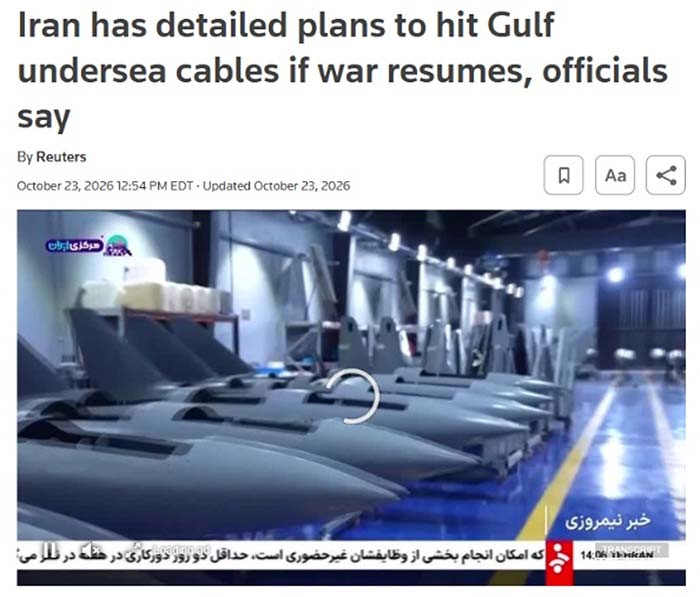
Two days earlier, a Revolutionary Guard official said Iran could strike seven major cables beneath the Strait of Hormuz.
A successful attack could disrupt regional communications, reroute data traffic, and create serious problems for businesses that depend on reliable international connectivity.
But here’s what caught my attention.
Iran may be threatening the cables themselves. But China controls most of the world’s supply of a material that goes inside them.
And that exposes a much bigger problem for America.
Most investors think about the internet in terms of software, semiconductors, data centers, and artificial intelligence.
NVIDIA (NVDA) makes the chips. Microsoft (MSFT), Amazon (AMZN), and Google (GOOG) build the infrastructure. Meta (META) is laying Project Waterworth, the longest undersea cable ever announced, at 31,000 miles.
But none of that technology operates in isolation.
Behind those investments is an enormous physical network of cables, optical components, sensors, and specialized materials.
One of those materials is germanium.
Most of the world’s fiber-optic cable carries germanium in its core. It’s what keeps the light on track over long distances. It’s also needed for specialized infrared imaging systems, military surveillance equipment, and advanced electronics.
Here’s the problem.
China dominates global germanium production and processing. In 2023, Beijing introduced export controls on germanium and gallium, requiring licenses before shipping these materials abroad.
In December 2024, China tightened restrictions further, banning germanium exports to the United States.
Then, last November, Beijing suspended that ban for one year.
The suspension runs out on November 27. After that, Beijing can switch the ban back on whenever it chooses.
Suddenly, a material most Americans had never heard of became another front in the technological competition between Washington and Beijing.
And this isn’t just about the internet.
Germanium is used in technologies found throughout America’s defense industry, including infrared sensors, surveillance systems, and specialized optical equipment.
And even during suspension, China’s ban on shipping these materials to U.S. military users never lifted. Washington knows about the problem.
Congress has already taken steps to reduce the Pentagon’s dependence on Chinese-sourced critical materials, with additional restrictions scheduled in the coming years.
But there’s a difference between recognizing a problem and solving it. America can’t simply flip a switch and replace decades of foreign production capacity.
New mines take years to develop. Processing facilities require enormous investments. Manufacturers must qualify replacement materials before they go into sensitive military systems.
And every step takes time.
That’s why investors need to look beyond the companies building America’s military equipment.
Because the biggest opportunity may not involve producing more of a scarce material.
It may involve going around China altogether.
Iran’s plans expose the physical weak point of global communications.
China’s restrictions expose an industrial one: America’s dependence on foreign-controlled materials.
The companies that close the gaps may become just as important as the companies building the infrastructure itself.
Once a replacement is approved for a major military program, it can remain part of that system for decades.
Washington is investing billions in strengthening domestic supply chains. Defense contractors are searching for alternatives to restricted materials.
The question isn’t simply which companies will benefit from increased defense spending. It’s which companies already have solutions to problems the industry is only beginning to confront.
And one emerging American technology deserves a closer look…
On Wednesday, November 11, Monument Traders Alliance’s Head Innovations Strategist Matt McCall – a 25-year market veteran and former Fox Business contributor – will present a free broadcast called “The Edison Prophecy.”
Matt will share details on a small American company holding the exclusive license to manufacture a U.S. Navy invention in development for nearly 30 years. The technology could help reduce America’s dependence on critical materials controlled by China.
Everyone who attends will also receive a free bonus stock pick.
November 11 is just 16 days before Beijing’s suspension runs out. Reserve your free spot for The Edison Prophecy right here.
