
© 2026 Monument Traders Alliance, LLC

Publisher’s Note: Quick heads up. Starting Tuesday, July 28, we’re sending our Trade of the Day Watchlist ideas exclusively to our free VIP text alert list.
If you’re already signed up, you don’t need to do anything!
If you’re not yet signed up, great news… we’re launching a new benefit!
You’re now invited to Wakeup Watchlist LIVE – a live session every Monday morning where our Senior Analyst and Host Chris “CJ” Johnson breaks down the top opportunities of the week from Bryan, Karim, and Nate.
But make sure you sign up right here to get it!
– Stephen Prior
In 2008, I watched nearly half of my portfolio disappear. I didn’t panic sell, and that turned out to be the right call. But it was also one of the worst stretches of my professional life.
What made it even worse… I’d been doing this for decades.
I was running money, teaching other people how to do it, and writing about markets.
I thought I was diversified, and it turned out I owned a lot of different things that all went down for the exact same reason.
Pull Up Your Account Before Reading Any Further
Do it. Not what you meant to buy, not what’s on your watchlist. What’s actually in there right now.
Ask yourself how many of those positions would fall together on the same ugly Monday.
If the answer is most of them, then what you own isn’t a portfolio, it’s one bet wearing a lot of different ticker symbols, and you’ll find that out on a day you didn’t expect.
The S&P 500 fell 37% in 2008 and closer to 55% peak to trough. Consumer staples dropped 15%. Gold finished the year up 5.5%. Nobody who owned staples that year was smarter than the guy who owned financials, they just owned something that got paid for a different reason.
The Flaw In My Own Argument
I’d rather you hear this from me than find out the hard way. For the first few weeks of a real crash, none of what I just told you works.
When the margin calls go out, the big funds don’t sell what they want to sell, they sell what they’re able to sell.
They need cash by Friday and they raise it wherever there’s still a bid, which means your defensive names get dumped alongside the garbage, even though nothing changed about the business.
Morningstar (MORN) went back and studied the worst week of February 2020 and found essentially no performance difference between growth funds, value funds, high-yield funds, momentum funds and quality funds.
Everything got hit the same way at the same time. Correlations that normally sit around 0.35 went above 0.80 in 2008.
So, if you’re expecting your utilities to print green on the day the market drops 6%, you’re going to be disappointed. But the real issue is you’re probably going to do something expensive about it.
Non-correlation isn’t a shield you hold up against a bad day, it’s a cushion that changes how far you fall over an entire bear market and how long it takes to climb back out.
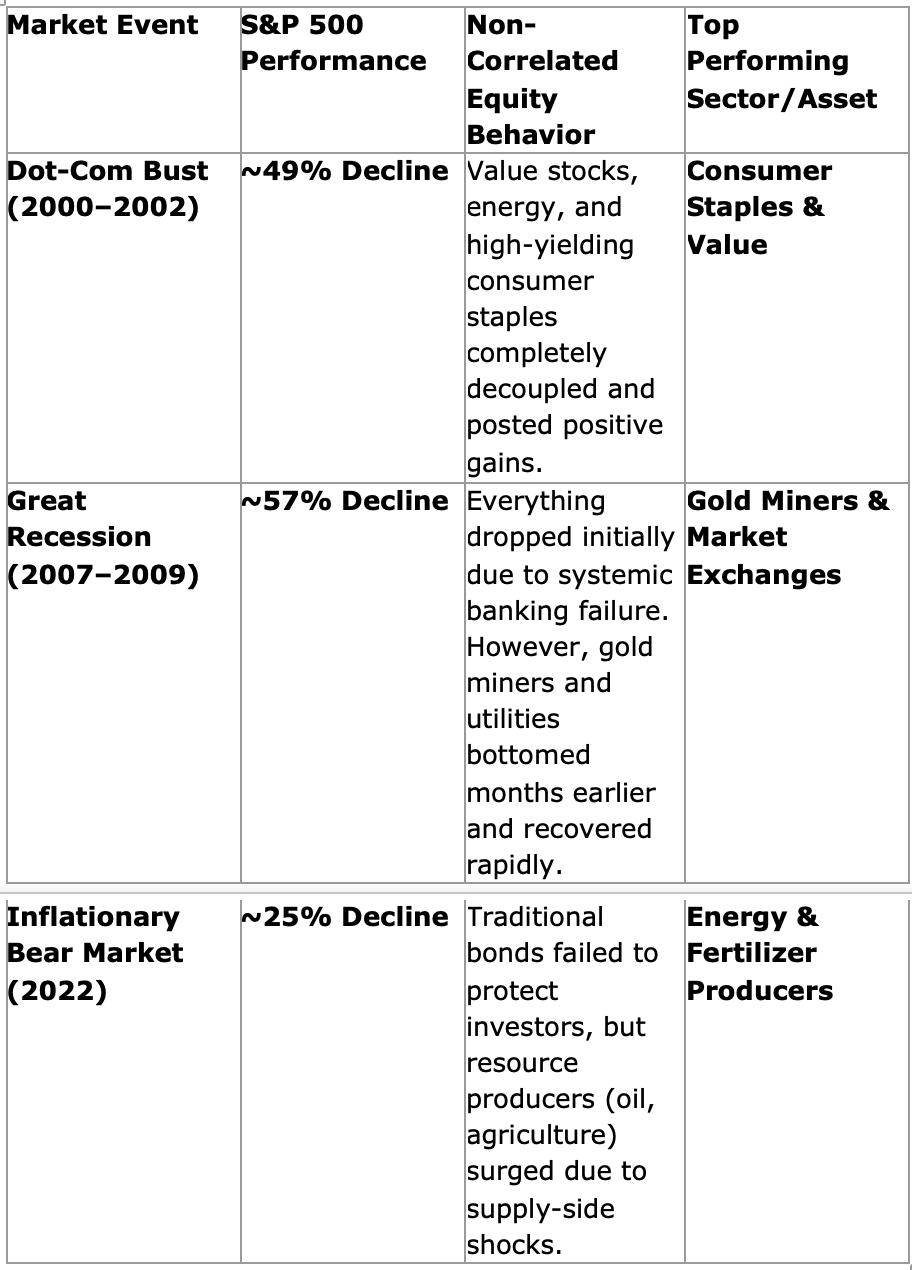
Look at the middle row. Everything dropped in 2008, including the good stuff, but the gold miners and the utilities bottomed months before the index did… and came off the floor faster.
In the first 30 days, you couldn’t tell them apart.
By the end of the cycle, they were in a completely different place.
Answer Me Honestly
If every technology position you own dropped 30% next month, what else in that account would be making money?
I’m not asking what would hold up better. I’m asking what would actually be up.
If the answer is nothing, you own one idea six different ways.
Which brings me to where I’m looking right now…
Your Action Plan
Gold miners just got taken apart. GDX fell 21% in the second quarter, from $96 in early April to around $75 by the end of June, and gold itself had its worst quarter in 13 years.
And while that’s the kind of number that makes most people close the tab, it’s the kind that makes me open a spreadsheet.
The stocks got destroyed. The businesses didn’t. The top 25 miners are guiding all-in sustaining costs around $1,703 an ounce while gold trades well above that, which means they’re printing money right now and about to report what looks like their second-best quarter on record.
A sector nobody wants, where the earnings are intact and the costs haven’t moved… This is exactly the kind of position we look for.
Fun Fact Friday
The guy who invented the math for “perfect diversification” didn’t even use it on his own money. Harry Markowitz won a Nobel Prize for figuring out the formula for building an ideal portfolio. But when it came time to invest his own retirement savings, he skipped the math entirely and just split everything 50/50 between stocks and bonds. His reasoning: he didn’t want to feel regret either way… too much in stocks if the market crashed, or too little if it soared.
Even the man who invented the formula went with his gut instead of his own equations.
