
© 2026 Monument Traders Alliance, LLC

Let’s start today with a little experiment.
What one company embodies the AI revolution in your mind?
Not your favorite AI stock. The company that represents this incredible bull market more than any other.
Got it? Write down its ticker symbol.
Now, I’ll bet you an ice cream sundae that the stock you just picked gained more than 80% during the early stages of the dot-com bubble’s collapse in 2000.
Don’t believe me? Keep that ticker handy. There’s a surprise coming.
This week, we asked Monument Traders LIVE members what was haunting their portfolios.
More than 45% identified a market crash as their biggest fear. Another 22.6% pointed to an AI bubble bursting.
But here’s the most revealing number: 38.7% want help knowing when to buy, sell, or raise cash.
Investors aren’t just afraid of a correction. They’re worried about recognizing when a healthy pullback becomes something much worse.
Frankly, I think about that too, which is why I have a rule for that ticker you wrote down.
Earnings are soaring, but valuations are stretched, and sentiment is doing more of the heavy lifting.
When sentiment gets involved, expensive stocks can always become more expensive. The challenge is recognizing when investors decide they’ve paid enough.
For that, let’s go back 26 years.
During the dot-com bubble, Cisco Systems (CSCO) became the poster child for the internet revolution.
Its networking equipment made the internet possible, and Wall Street got used to Cisco beating estimates “by a penny” quarter after quarter.
Every 10% or 20% pullback was another buying opportunity.
Until it wasn’t.
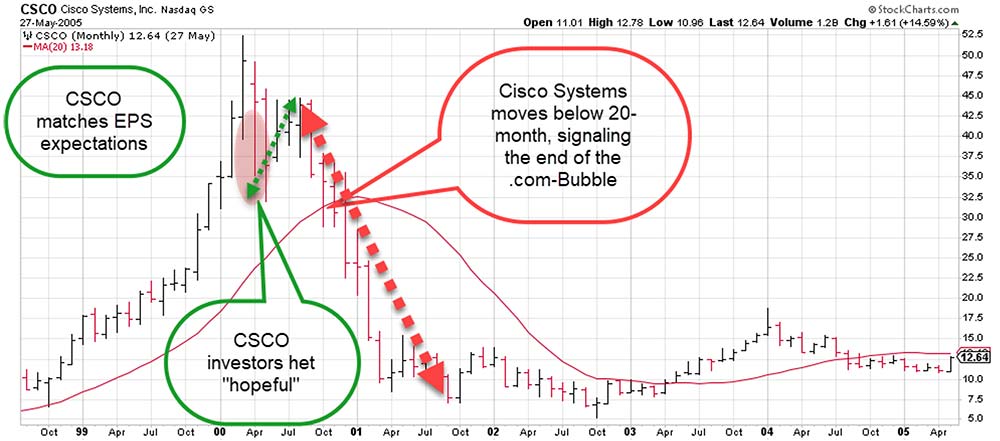
After peaking in March 2000, Cisco plunged roughly 40%, then staged a powerful rebound that gave investors hope the bull market wasn’t finished.
That word “hope” is one of the most dangerous words in investing. Write that down.
By late 2000, that rebound had rolled over. In February 2001, Cisco missed by a penny for the first time in more than six years and warned that revenue growth was slowing.
The stock had already broken below its 20-month moving average by then, ending a bull run that started before 1993.
The company investors expected to grow forever was suddenly struggling to grow at all.
Eventually, Cisco lost more than 80% of its value and didn’t return to its all-time high until December 2025.
The hope trade had run its course.
While Cisco was collapsing, another technology company was doing something remarkable.
NVIDIA (NVDA).
Yes, that NVIDIA.
Back then, it was a young graphics-chip company for gaming computers. In 2000, it launched GeForce2 and won a deal to supply processors for Microsoft’s (MSFT) upcoming Xbox.
While internet stocks crumbled, NVIDIA shares nearly doubled during the spring of 2000.
A year later, NVIDIA was reaching new highs while Cisco traded roughly 80% below its peak.
Two technology companies. Two completely different outcomes.
The collapse of one technology trade didn’t eliminate opportunities in technology. It changed where investors found them.
I’m betting you wrote NVDA.
Am I right?
In 2000, NVIDIA was the emerging opportunity. Today, it’s the poster child of the AI revolutio… the Cisco of this cycle.
And that ticker may tell you when the AI bull is running out of time.
When I coached high school hockey, I taught my defensemen a simple trick.
Don’t watch the puck. Don’t watch the opposing player’s stick or shoulders.
Watch his beltline.
Why?
Because the body goes where the belt goes. Players can fake with their heads, shoulders, or sticks, but their hips tell you where they’re going.
The same principle applies to AI.
NVIDIA is the belt.
If you want to know where the AI trade is heading, watch NVIDIA.
Not the headlines. Not the latest AI-bubble prediction.
Here’s what I’m watching as this bull market matures.
First, Watch Earnings Expectations
NVIDIA routinely beats estimates and raises its outlook.
Eventually, that could change.
Watch for narrowing earnings surprises, decelerating revenue growth, and less aggressive forward guidance.
Remember Cisco. The real damage wasn’t the penny miss. It was realizing that future growth couldn’t support investors’ expectations.
Second, Watch for the Hope Trade
NVIDIA is climbing a wall of worry. Investors love it, but they flinch every time earnings approach.
It already fell roughly 38% into April 2025 on tariff fears, with the AI growth story fully intact.
When a fundamental breakdown comes, I wouldn’t be surprised by a 30% to 40% decline followed by a 20%-plus rebound.
Investors have spent years learning to buy every dip. They won’t abandon that behavior overnight.
But if earnings expectations are deteriorating, that rebound could be the hope trade.
And hope is a terrible exit strategy.
Third, Watch the 20-Month Moving Average
It’s my quantified measure of the longer-term trend, smoothing out nearly two years of price action to filter out temporary volatility.
A sustained break below that average, especially alongside weakening earnings and failed rallies, would signal NVIDIA’s long-term uptrend is in trouble.
It’s not perfect, but it gives us something more valuable than an opinion.
An objective measurement.
When the AI bull market eventually ends, opportunities won’t disappear.
In 2000, while investors desperately clung to Cisco’s former glory, a new technology leader was emerging.
The same thing can happen again.
Money leaving today’s AI leaders won’t all hide in bank CDs or under mattresses. Some will go defensive, but plenty will hunt for the next great growth opportunity.
That’s where we’ll be looking.
Our job isn’t to predict the exact day the AI bull market ends.
It’s to recognize when the evidence changes, avoid getting trapped in the hope trade, and identify where the next opportunity is emerging.
We’ll be watching NVIDIA’s beltline closely.
Next week, we’ll discuss how to hedge your portfolio when those warning signs begin flashing.
Because recognizing trouble is important.
Knowing what to do about it separates prepared investors from the crowd.
