

The market is looking at SpaceX’s (SPCX) first earnings report and today’s lockup expiration as reasons to avoid the stock.
Traders see something completely different.
They see opportunity.
The next two months could become one of the best trading environments SpaceX will ever offer.
Three separate catalysts are converging at the same time, each capable of producing the type of daily price swings that short-term and day traders thrive on.
If you’re an active trader, this is exactly the type of environment you wait for.
SpaceX’s earnings didn’t disappoint because the business is broken, far from it. The company appeared to disappoint because expectations collided with reality.
The quarter itself was impressive. Revenue surged 92% year over year, Starlink continued adding subscribers at a remarkable pace, the AI business posted explosive growth, and each of the company’s operating segments showed strong momentum.
But investors weren’t focused on the revenue… they were looking at the spending.
SpaceX’s CapEX topped $18 billion during the quarter as the company accelerated investments in AI infrastructure, Starlink, and Starship. Management also made it clear that spending will remain elevated over the coming quarters.
We’ve seen Capex spending act as the “third rail” when it comes to investors reactions to earnings over the last two quarters.
The bulls see investments that could dominate the next decade.
The bears see years of heavy spending before those investments fully pay off.
When investors can’t agree on valuation and outlook, volatility expands.
That’s exactly where short-term traders make their money.
Today marks another major event.
More than 911 million previously restricted shares are now eligible to trade, more than doubling SpaceX’s publicly available float.
Some early investors will undoubtedly sell to lock in gains from shares they’ve held since early pre-IPO days. Others may decide to hold. Institutional investors that have been waiting for additional liquidity may finally begin building larger positions.
Nobody knows how those forces balance out… that’s what creates volatility and opportunity.
The lockup itself isn’t the catalyst, the uncertainty surrounding it is.
As buyers and sellers battle to determine where SpaceX should trade, volatility is likely to remain elevated. For short-term traders, that’s exactly the environment they’re looking for.
One of the most overlooked catalysts isn’t on the earnings report or the lockup calendar.
It’s the short interest.
Roughly $25 billion has been wagered against SpaceX, making it one of the most heavily shorted stocks in the market.
Every one of those positions eventually has to be closed, either because the stock is moving against the shorts or the shorts want to lock in profits.
Either way, closing a short position requires buying shares of SpaceX.
I’m not predicting an imminent short squeeze.
No one can.
But I am pointing out that another potential source of significant buying pressure exists just beneath the surface.
If sentiment begins to improve or selling pressure starts to fade, short covering could quickly add fuel to a rally.
That’s another catalyst traders should have on their radar.
Here’s the part almost nobody is talking about.
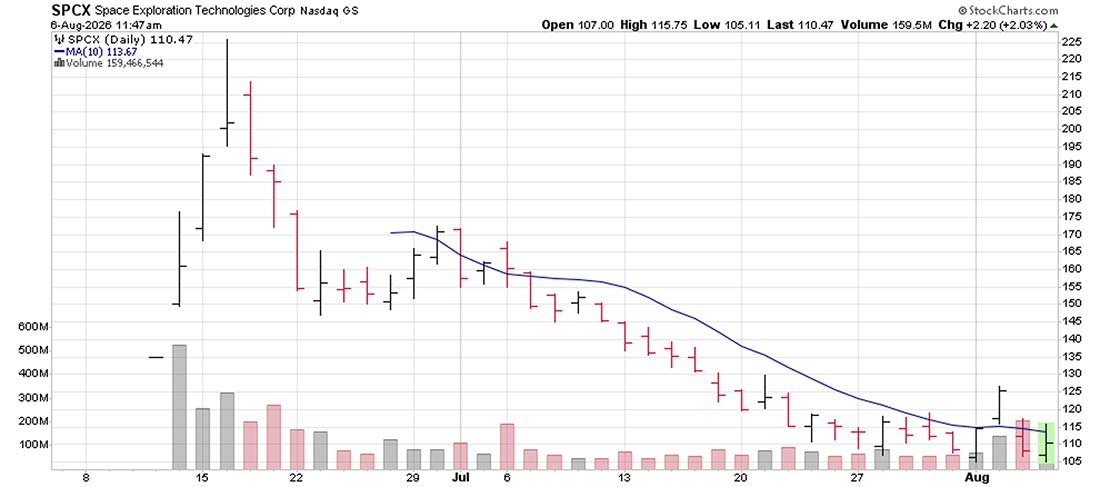
SpaceX has only been trading for a little over a month, which creates a window that favors short-term and day traders.
Most institutional trading systems and average investors rely heavily on established trends, moving averages, support and resistance levels, and long-term technical indicators.
Those tools simply don’t have enough history to fully develop in a stock this new.
This creates a temporary window where short-term price action carries far more influence than traditional technical structure.
|
Experienced day traders who focus on momentum, volume, order flow and intraday price action have an advantage that won’t last forever.
Eventually, SpaceX will accumulate enough trading history for the 50-day moving average, longer-term trend analysis, and institutional technical models to take over.
In my experience, that process takes roughly three to six months.
Until then, this is a trader’s market as volatility develops into trends.
I wrote this article the day before the SpaceX IPO, detailing the approach that makes sense for most long-term investors looking to buy SpaceX shares.
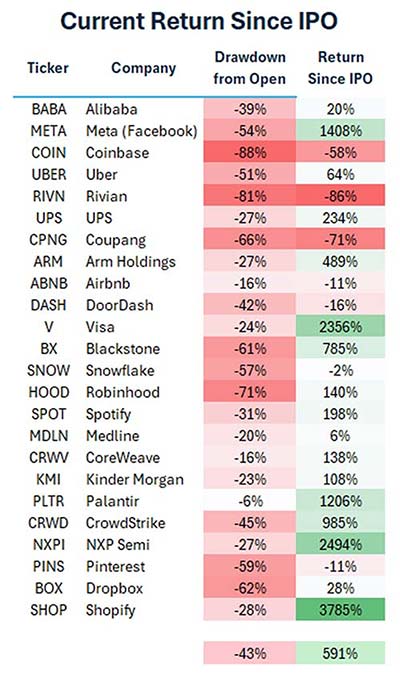 |
Over the last 20 years, the average IPO declines roughly 40% before reaching its first-year low. On average, that low doesn’t occur until about 225 days after the company begins trading.
Some of the market’s biggest long-term winners followed that exact path.
These IPOs rewarded patient investors, not impatient ones.
That’s why my strategy for SpaceX hasn’t changed.
Rather than trying to guess the exact bottom, I plan to gradually build a position using dollar-cost averaging throughout the stock’s first year as a public company. That approach removes the emotion, lowers my average cost basis if the shares continue to weaken, and lets history work in my favor instead of against me.
Traders should hope SpaceX remains volatile.
Long-term investors should hope it remains cheap.
Either way, SpaceX is offering opportunities for both kinds of investors. To best take advantage of it, you need to join Nate Bear’s Open House next week.
He’s an expert at trading volatility, and the conditions couldn’t be more perfect for this SpaceX setup.
