
© 2026 Monument Traders Alliance, LLC

There’s a significant shift taking place beneath the surface of the stock market, and it’s telling us a lot about what Wall Street expects over the next few weeks.
Institutional money is moving out of the technology trade and into three sectors that investors largely ignored for most of the year: Consumer Staples, Health Care, and Utilities.
This isn’t random buying, and I don’t believe it’s the beginning of some great awakening about the investment potential of toothpaste, prescription drugs, and electric companies.
This is just one way that Wall Street protects its profits ahead of the election.
More importantly for us, this rotation could be setting up the next significant buying opportunity in stocks. (My colleague Nate Bear calls this rotation a “Money Shock”… and next Wednesday he’s showing us what’s going on and how to play. Join him for free here.)
I’ve always maintained that price and volume tell you more about what investors are actually doing than what they’re saying on television.
Look at the relative-strength trends of Consumer Staples (XLP), Health Care (XLV), and Utilities (XLU) compared with the S&P 500.
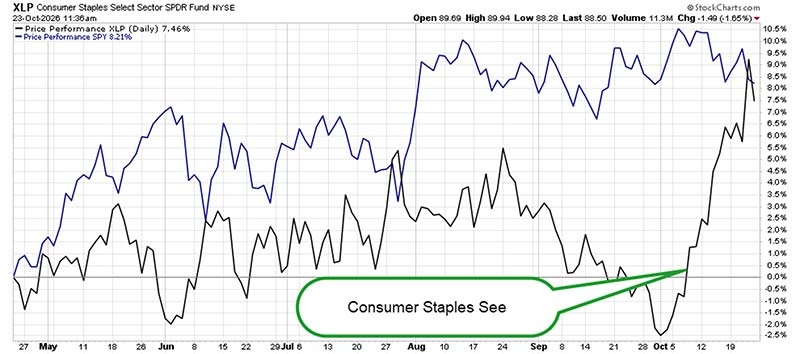
For most of the year, these sectors couldn’t keep pace with the broader market.
That changed about two weeks ago.
All three defensive sectors began showing relative strength improvements, supported by higher prices and expanding trading volume.
Thursday’s trading provided a perfect example. The S&P 500 dropped 1.2%, while Consumer Staples gained 2.6%, Utilities advanced 1.3%, and Health Care added 1%.
That’s a substantial performance gap for a single trading session.
And around an election, single sessions can get a lot more lopsided than that. Nate has a trade lined up for the first session after the polls close. More here.
But the big investors, the Whales, are looking for a place to tuck their money as the market works through an event.
With the November 3 midterm elections approaching, institutional money managers have a problem.
They’ve made substantial profits riding the technology and AI trade higher. But those gains have come with increasingly concentrated positions in companies that are priced for continued earnings growth and aggressive AI investment.
That’s a lot of risk to carry into an election.
Remember, these managers aren’t paid to be heroes. They’re paid to manage money.
With political uncertainty increasing, the easiest decision is to reduce exposure to the most volatile positions and move capital into areas that traditionally hold up better when investors become nervous.
That’s exactly what we’re seeing.
This gives institutional managers a way to remain invested without carrying the same level of risk.
It’s a defensive trade, not necessarily a bearish outlook on the stock market.
That’s an important distinction.
There’s another piece of this rotation that I believe investors are overlooking.
Not all the money coming out of technology is moving into defensive stocks.
Some of it’s going straight to cash.
Why wouldn’t the Whales take some money off the table?
Selling a portion of those profitable positions accomplishes two things. It locks in gains and provides liquidity for the next buying opportunity.
And that’s where this gets interesting.
Cash sitting on the sidelines isn’t necessarily money leaving the market permanently. It’s buying power waiting for a reason to come back.
The question isn’t whether that money will eventually be redeployed. It’s when and where.
I expect the defensive rotation to continue through much of next week as professional managers finish positioning their portfolios ahead of Election Day.
But that’s only the first half of the trade.
The second half begins when election uncertainty starts to disappear.
Historically, stocks have performed well following midterm elections. The reason isn’t necessarily which political party wins. It’s that investors can finally stop guessing about the outcome and get back to evaluating earnings, interest rates, and economic conditions.
And this year, they’ll potentially have a larger cash position available to put to work.
There’s one complication.
I don’t expect the political uncertainty to disappear automatically on election night. The possibility of contested results, legal challenges, and delayed outcomes could keep money managers defensive longer than usual.
That means the traditional post-election rally could get off to a late start.
But a delay doesn’t necessarily eliminate the seasonal opportunity.
It may simply push the next wave of institutional buying further into November.
I’m not interested in guessing which day Wall Street will decide the election is behind us.
I’ll let the technical indicators tell me.
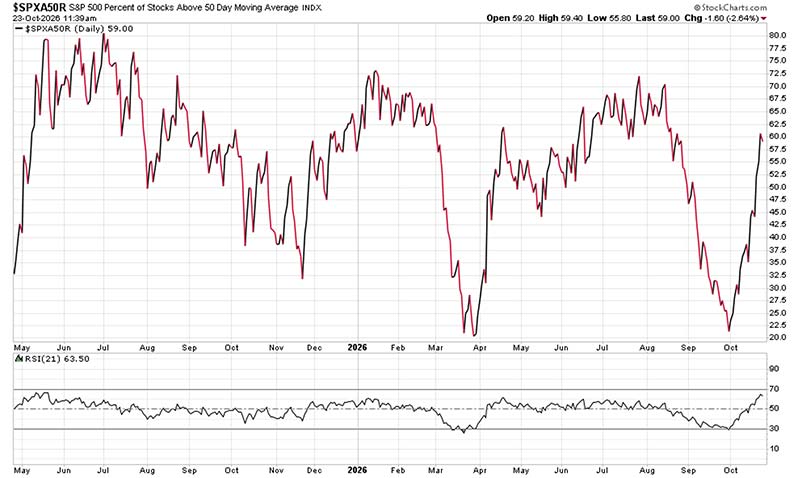
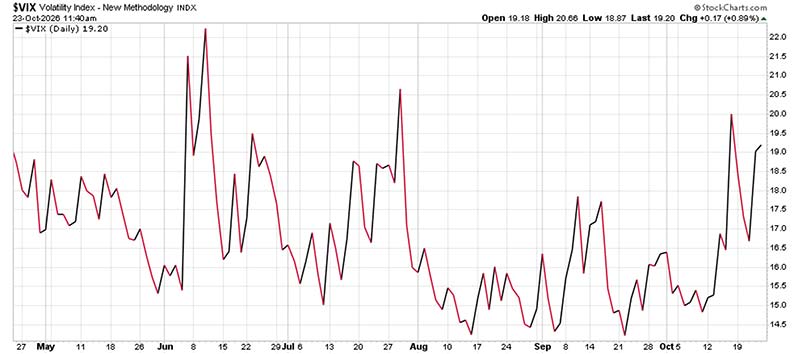
None of these indicators works perfectly on its own. Together, they should provide a pretty good picture of when the next allocation cycle is getting underway.
The rotation into defensive sectors isn’t a mystery. Institutional investors are protecting profits and raising cash ahead of an election that could create another round of volatility.
And don’t assume that every dollar leaving technology today will return to the same stocks tomorrow. The next rally could have a different set of leaders.
Nate has proprietary research on which ones move first, and he’s sharing it live next Wednesday at 2 p.m. ET.
That’s why relative strength and market breadth will matter.
Wall Street is playing defense right now. The opportunity comes when the big money decides it’s time to go back on offense.
P.S. The question isn’t if the Whales’ cash comes back into stocks. It’s when and where. I’m letting my three signals answer that. Nate’s working the same question from a different angle, and he’s zeroed in on one specific day.
He calls it the Midterm Money Shock: billions of dollars flooding from one industry into another as soon as the votes are counted. In 2018, the day after the last Trump midterm, Molina soared 11% and HCA jumped 5%, with Amazon, Google, and Microsoft rallying right behind them. Notice which sector led the way? Health Care, one of the same three sectors the Whales are crowding into right now.
At noon on November 4, the day after the polls close, Nate plans to issue a trade he believes gives you the chance to double your money in about a week. Next Wednesday, October 28 at 2 p.m. ET, he’s going live to walk through the pattern and the trade he’s targeting.
It’s free to attend, but seats are limited. Click here to reserve your seat.
